

















































India Executes Operation Sindoor, Strikes Terror Camps in Pakistan: PM Modi Addresses Nation


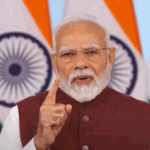
New Delhi, May 12, 2025 – In a powerful address to the nation on Buddha Purnima, Prime Minister Narendra Modi hailed the success of Operation Sindoor, a decisive military operation launched on May 7, 2025, targeting terrorist camps in Pakistan. The operation was India’s response to the brutal terrorist attack in Pahalgam, Jammu and Kashmir, on April 22, which claimed the lives of innocent civilians and shook the nation. Modi’s speech underscored India’s resolve against terrorism, its military prowess, and a new policy framework to combat terror, while warning Pakistan of further consequences if it continues to support terrorism.
Tribute to Armed Forces and National Unity
“Dear countrymen, Namaskar!” Modi began, paying heartfelt tributes to India’s Armed Forces, intelligence agencies, and scientists for their courage and precision in executing Operation Sindoor. He saluted the nation’s brave soldiers, dedicating their valor to “every mother, sister, and daughter of the country.” The Prime Minister highlighted the unity of India’s citizens, political parties, and communities in demanding strong action against terrorism following the Pahalgam attack, which he described as a “gruesome face of terror” and a “disgusting attempt to break the harmony of the country.”
The Pahalgam attack, where terrorists segregated victims by religion and brutally killed them in front of their families, left the nation in grief. Modi expressed personal anguish, noting that the barbarity “shook the nation and the world.” In response, India granted its forces full freedom to “wipe out the terrorists,” signaling a zero-tolerance policy.
Operation Sindoor: A Pledge of Justice
Modi described Operation Sindoor as more than a military operation—it is “a reflection of the sentiments of crores of people” and “an unbroken pledge of justice.” On the night of May 6 and early morning of May 7, Indian forces launched precision missile and drone strikes on terrorist camps in Pakistan, targeting hideouts in Bahawalpur, Muridke, and other locations. These sites, Modi claimed, were “universities of global terrorism,” linked to major attacks worldwide, including 9/11, the London Tube bombings, and decades of terrorism in India.
The strikes, Modi asserted, killed over 100 dreaded terrorists, including figures who had operated freely in Pakistan for decades, and destroyed their training centers. “When India’s missiles attacked terror bases, not just the buildings of terrorist organizations were shaken, but their morale was also shaken,” he said. The operation caught terrorists off-guard, as they “had not even imagined” India’s bold decision, made possible by the nation’s unity and “Nation First” spirit.
Pakistan’s Escalation and India’s Counteraction
Modi accused Pakistan of responding with aggression instead of supporting India’s anti-terrorism efforts. Pakistan targeted Indian schools, colleges, gurudwaras, temples, and military installations with drones and missiles, which India’s advanced air defense systems, including the S-400, neutralized in the sky. In retaliation, Indian drones and missiles struck Pakistani airbases, causing significant damage. “In the first three days, India destroyed Pakistan to an extent that it had not even imagined,” Modi stated.
By May 10, Pakistan, “deeply disappointed” and “freaked out,” contacted India’s Director General of Military Operations, pleading for a ceasefire and promising no further terrorist activity or military adventurism. Modi emphasized that India has only “postponed” its retaliatory action, warning that future steps will depend on Pakistan’s behavior. “We will judge every step taken by Pakistan on the basis of the attitude it adopts,” he said.
A New Policy Against Terrorism
Operation Sindoor marks a new standard in India’s fight against terrorism, Modi declared, outlining three key principles:
Decisive Response: Any terrorist attack on India will be met with a befitting reply, targeting the roots of terrorism on India’s terms.
No Nuclear Blackmail: India will strike terrorist hideouts, regardless of nuclear threats.
No Distinction: Governments that patronize terrorism will be treated as complicit with terrorists.
Modi cited Pakistan’s military officials attending terrorists’ funerals as evidence of state-sponsored terrorism, urging the world to recognize this “ugly truth.” He reiterated that talks with Pakistan will focus solely on terrorism and Pakistan-occupied Kashmir (PoK), rejecting trade, water-sharing, or other negotiations. “Terror and talk cannot go together. Water and blood cannot flow together,” he asserted.
Made-in-India Defense and Global Message
The Prime Minister praised India’s indigenous defense capabilities, noting that Made-in-India weapons proved their authenticity in Operation Sindoor. “The world is watching—Made-in-India defense equipment for 21st-century warfare, its time has come,” he said. Modi positioned India’s actions as a global stand against terrorism, calling for “zero tolerance” to ensure a better world.
He warned Pakistan that its support for terrorism will lead to its own destruction, urging it to dismantle its terror infrastructure for its survival. On the occasion of Buddha Purnima, Modi invoked Lord Buddha’s path of peace, emphasizing that peace requires strength. “The path to peace also goes through power,” he said, underscoring the need for a powerful India to fulfill the dream of a developed nation.
Continued Vigilance and National Pride
Modi assured the nation that India’s Army, Air Force, Navy, Border Security Force, and paramilitary forces remain on high alert. He highlighted India’s historical victories over Pakistan and Operation Sindoor’s demonstration of superiority in both traditional and new-age warfare. “I salute the courage of the people of India and the unity of every Indian,” he concluded, ending with a resounding chant: “Bharath Mattha ki jai !”
As India monitors Pakistan’s actions, Operation Sindoor has set a new benchmark in the fight against terrorism, reinforcing the nation’s commitment to protecting its citizens and ensuring peace through strength.